AI-Powered
Smart Critical Care
Revolutionize patient care with Clinext. Featuring Automated SOFA Scoring, Sepsis Prediction, and real-time IoMT connectivity. Seamless data continuity from the OR to the ICU, powered by Explainable AI (XAI).
Live AI Engine Sandbox
Forget static demos. Experience Clinext's real-time analysis engine with your own data or live simulations right now.
Input Data Stream
Select Data Source:
{
  "resourceType": "Bundle",
  "type": "collection",
  "meta": {
    "source": "urn:CLINEXT_IOMT:ICU_01:CDSS_AI:SERVER",
    "lastUpdated": "2025-01-14T12:00:00Z"
  },
  "entry": [
    {
      "resource": {
        "resourceType": "Patient",
        "id": "123456789",
        "name": [{"family": "HASTA", "given": ["ANONIM"]}]
      }
    },
    {
      "resource": {
        "resourceType": "Observation",
        "code": {"coding": [{"system": "http://loinc.org", "code": "8867-4", "display": "Heart rate"}]},
        "valueQuantity": {"value": 135, "unit": "bpm", "code": "/min"},
        "interpretation": [{"code": "H", "display": "High"}]
      }
    },
    {
      "resource": {
        "resourceType": "Observation",
        "code": {"coding": [{"system": "http://loinc.org", "code": "8480-6", "display": "Systolic blood pressure"}]},
        "valueQuantity": {"value": 85, "unit": "mmHg", "code": "mm[Hg]"},
        "interpretation": [{"code": "L", "display": "Low"}]
      }
    },
    {
      "resource": {
        "resourceType": "Observation",
        "code": {"coding": [{"system": "http://loinc.org", "code": "2708-6", "display": "Oxygen saturation"}]},
        "valueQuantity": {"value": 92, "unit": "%", "code": "%"},
        "interpretation": [{"code": "L", "display": "Low"}]
      }
    },
    {
      "resource": {
        "resourceType": "Observation",
        "code": {"coding": [{"system": "http://loinc.org", "code": "6690-2", "display": "Leukocytes [#/volume] in Blood"}]},
        "valueQuantity": {"value": 22.5, "unit": "10*3/uL", "code": "10*3/uL"},
        "interpretation": [{"code": "H", "display": "High"}]
      }
    },
    {
      "resource": {
        "resourceType": "Observation",
        "code": {"coding": [{"system": "http://loinc.org", "code": "32693-4", "display": "Lactate [Moles/volume] in Blood"}]},
        "valueQuantity": {"value": 5.2, "unit": "mmol/L", "code": "mmol/L"},
        "interpretation": [{"code": "H", "display": "High"}]
      }
    },
    {
      "resource": {
        "resourceType": "Observation",
        "category": [{"coding": [{"system": "http://terminology.hl7.org/CodeSystem/observation-category", "code": "exam"}]}],
        "code": {"text": "Ventilator Mode"},
        "valueString": "SIMV",
        "component": [{"code": {"text": "PEEP"}, "valueQuantity": {"value": 10, "unit": "cmH2O"}}]
      }
    },
    {
      "resource": {
        "resourceType": "MedicationAdministration",
        "status": "in-progress",
        "medicationCodeableConcept": {"text": "Noradrenaline"},
        "dosage": {"rateQuantity": {"value": 0.5, "unit": "mcg/kg/min"}}
      }
    }
  ]
}Console Output
EXECUTIVE SUMMARY
From Reactive Care to Predictive Critical Care Analytics
Transition to proactive patient management. An end-to-end digital critical care solution designed to reduce mortality rates and optimize hospital operational costs.
Real-Time IoMT Integration
Vendor-neutral data capture from ventilators, monitors, and anesthesia machines. Millisecond-level data streaming compliant with HL7/FHIR standards.
Sepsis Prediction AI
Advanced time-series forecasting algorithms detect Septic Shock risk 12 hours before clinical symptoms appear.
Automated SOFA Scoring
Eliminate manual calculation errors. Dynamic SOFA and APACHE scores updated instantly based on vital sign fluctuations.
Tailored Solutions for Every Role
Less Screen Time, More Patient Care
Your AI assistant analyzes thousands of data points in seconds. It frees you from alarm fatigue and alerts you only when it truly matters. For anesthesiology and surgical teams, OR data continues seamlessly once the patient transfers to the ICU.
Clinical Decision Support (CDSS)
Intelligent assistant modules supporting clinicians from the OR to discharge.
Early AKI Detection
Predicts Acute Kidney Injury risk 6 hours in advance by analyzing real-time urine output and fluid balance.
Smart Weaning Assistant
Analyzes RSBI and respiratory mechanics to identify the optimal window for extubation and ventilator weaning.
Fluid Management & Balance
Continuously monitors positive fluid balance and lung interaction to prevent 'Fluid Overload' complications.
AI Shift Handoff
Prevents information loss during shift changes. Generates automated reports summarizing critical events of the last 24 hours.
Drug Safety & DDI
Monitors infusion pumps to detect potential Drug-Drug Interactions (DDI) and dosage errors in real-time.
Automated Mortality Scoring
Calculates SOFA, APACHE II, and SAPS scores instantly using live vital data, removing manual data entry needs.
OR → ICU Contextual Handoff
When a patient transfers to the ICU, a summary of the last case — intraop hypotension exposure, anesthesia drug list, surgery type/duration, crisis events — is automatically included in the ICU's AI assessment, enriching post-op risk analysis.
Two-Stage AI Review
A primary model produces the clinical analysis; a second model acts as an auditor to independently check it. Outputs that pass the audit are presented to the clinician for information only.
Operating Room
Intraoperative Hypotension Prediction
Analyzes arterial waveform and vital trends to flag intraoperative hypotension risk minutes in advance.
Postoperative Complication Risk
Scores postoperative ICU need and complication risk from surgical data and comorbidities.
WHO Surgical Safety Checklist
A digital checklist flow covering sign-in, time-out, and sign-out phases. Every step is logged with signature/approval.
Real-Time Intraoperative Cockpit
Vitals, ventilation (MV, ETCO2), and anesthetic gas (SEVO, MAC) on one screen, updated every second.
Anesthesia Machine Integration
Read-only data streaming from anesthesia machines of different brands (Dräger, GE Aisys, etc.) via HL7/Medibus — vendor-neutral.
Automated Post-Op Handover Bundle
Generates a handover note automatically summarizing the checklist, event log, and vital trends for OR-to-ICU/PACU transfer, preventing information loss.
Drug Interaction & Dosage Safety
Real-time interaction alerts and dosage safety checks for anesthetic drugs, powered by the drug catalog.
One Universal Platform
For All Medical Devices
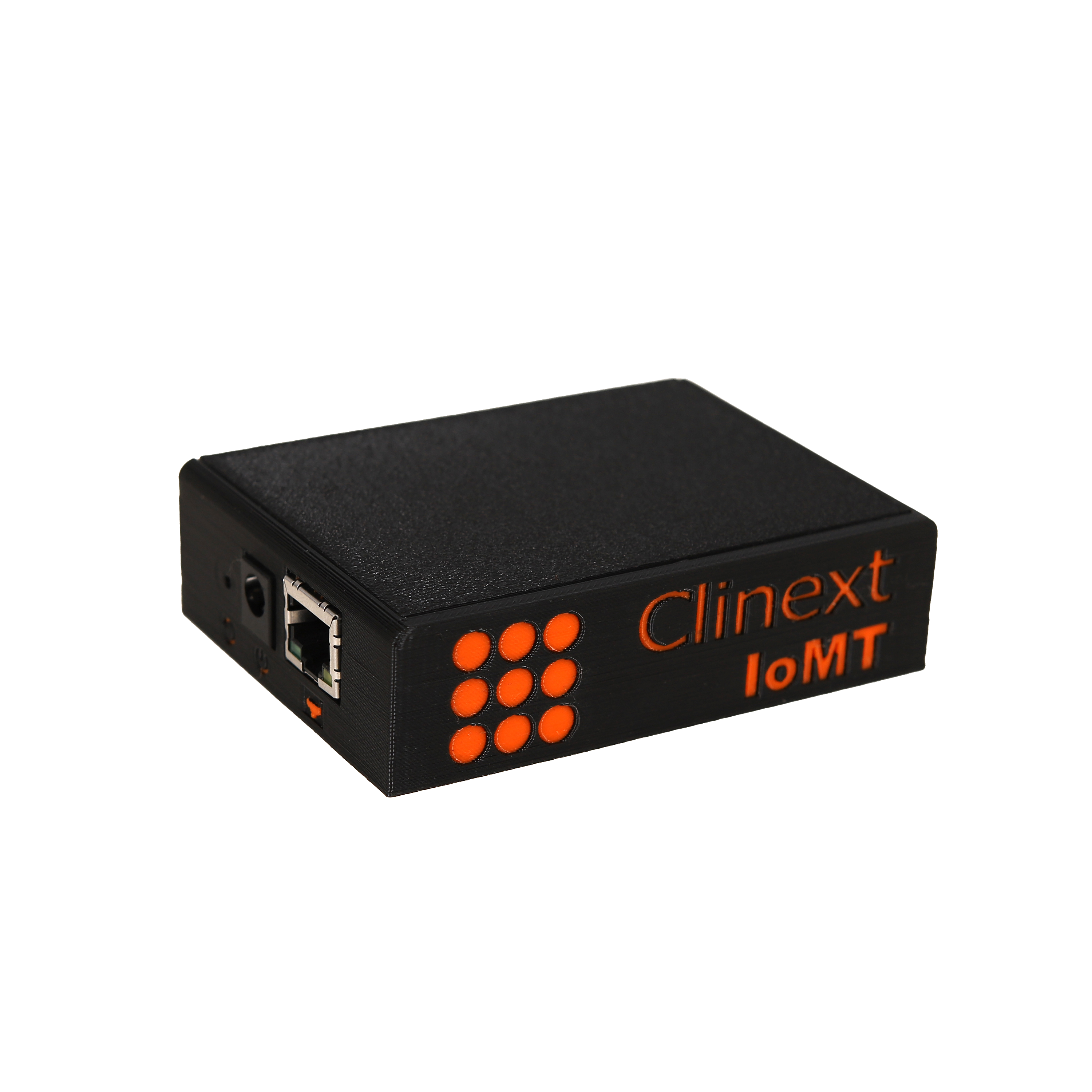
End the device chaos. Clinext IoMT Gateway connects hundreds of medical devices—from ventilators to infusion pumps—into a single unified system.
Extensive Driver Library
Plug-and-play support for Draeger, GE, Philips, Mindray, and more. No custom coding required.
Vendor-Neutral Architecture
Protect your hospital's hardware investment. A universal infrastructure that communicates with any device brand.
AI in Critical Care:
What the Literature Shows
The findings below come from independent published research on AI in intensive care and the operating room, and inform Clinext's approach. Clinical validation of Clinext's own models is ongoing at pilot sites.
Predictive Power
The SERA algorithm predicted sepsis onset 12 hours in advance with an AUC of 0.94.
The SepsisAI model reached 96.75% specificity — high specificity means fewer false alarms.
Operational Efficiency
Automated documentation raises charting completeness to 98%, against 95% with manual entry — and takes 6.1 minutes less.
Uploading vitals straight from the device drops the documentation error rate below 1%; manual charting measured 10%.
Cost & Survival
In a randomised trial, mean hospital stay fell from 13.0 to 10.3 days.
The TREWS early-warning system was associated with an 18.7% relative mortality reduction in patients whose alert was confirmed within 3 hours (590,736 patients, 5 sites).
Intraoperative Hypotension
The Hypotension Prediction Index predicted hypotensive episodes 5 minutes in advance with an AUC of 0.95.
Hatib et al., Anesthesiology 2018 — independent literature; not Clinext's own measurement.
From Data to Life-Saving Insights
"We've been in health IT since 1999. In 2018, we moved radiology to the cloud with imageRAD. Today with Clinext, our goal is not just to store data, but to transform it into a life-saving intelligence for ICUs."
Haluk Çelikel
Founder & CEO

Our Vision
To be the global standard-setter in AI-driven intensive care management and a trusted partner in health technology.
Our Mission
Transforming complex patient data into actionable clinical insights to enhance patient safety and reduce healthcare costs.
Key Objectives
- Developing proprietary technology to reduce software dependency.
- Reducing sepsis-related mortality with early warning systems.
- Optimizing ICU length of stay and operational costs.
TECHNOLOGY PARTNERS
TECHNOLOGY INFRASTRUCTURE & ECOSYSTEM







Clinext Yazılım A.Ş.
Bilişim Vadisi İzmir
25 Years in Digital Health
Clinext is built by the architects of imageRAD.com, the region's first cloud-based teleradiology platform. We are bringing our digital transformation expertise from radiology to the ICU.
FREQUENTLY ASKED QUESTIONS
Yes. Thanks to our native 'IoMT Gateway' technology supporting HL7 and FHIR standards, Clinext integrates seamlessly with thousands of vendor-neutral devices and all modern EHR infrastructures.